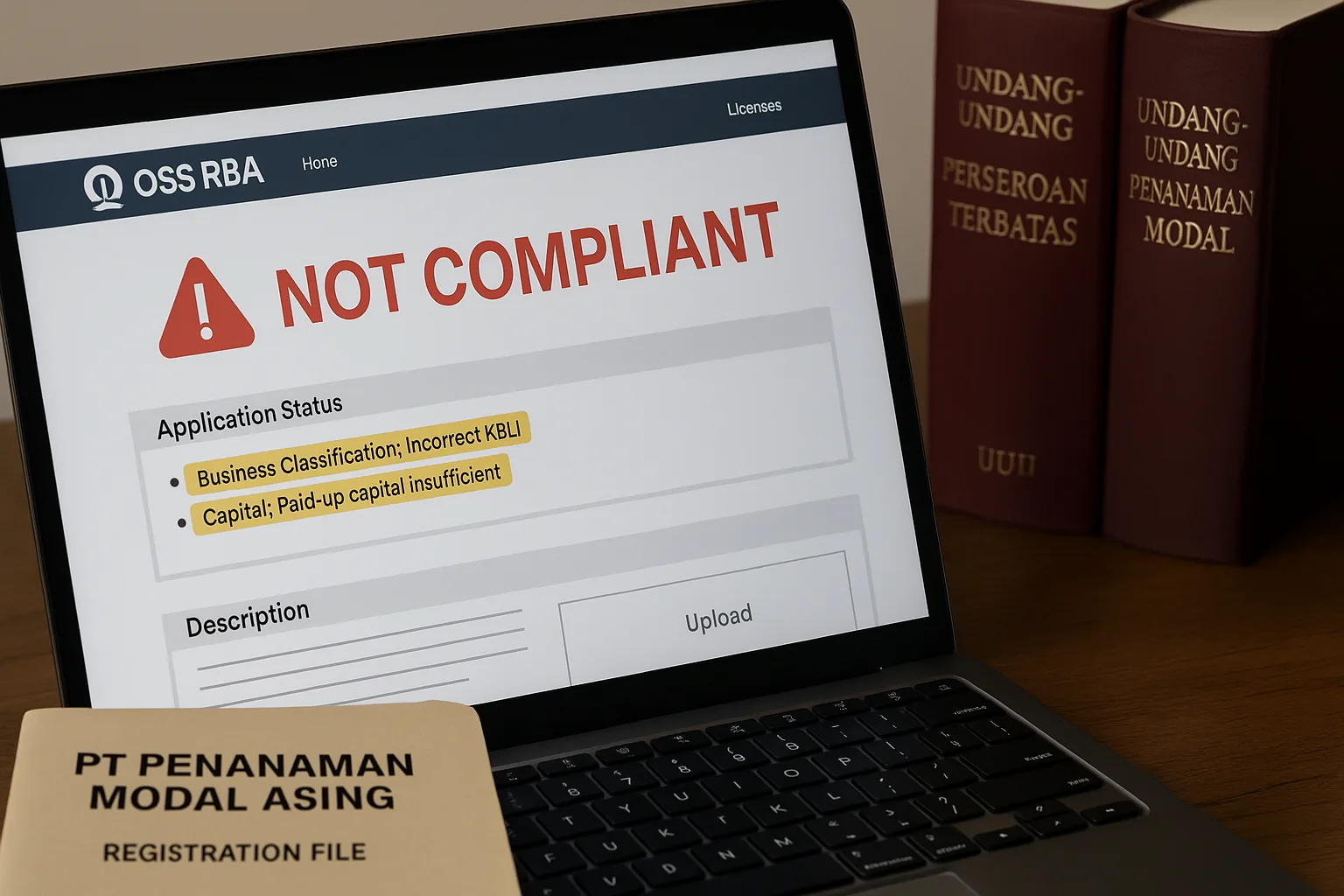
Submitting a PT Penanaman Modal Asing (PT PMA) application through Indonesia’s OSS RBA system should, in theory, make business licensing straightforward. But many foreign investors still face unexpected rejections, revision requests, or long delays. These issues usually don’t come from major violations—most rejections happen because of small mismatches, zoning issues, KBLI mistakes, or inconsistent documentation.
This article breaks down the most frequent reasons PT PMA applications are rejected, backed by available studies, government sources, and industry insights. It also includes practical guidance to help you avoid rejection and speed up your licensing.
Why OSS RBA Rejects PT PMA Applications
The OSS RBA system verifies information by cross-checking multiple government databases. It connects with:
- Ministry of Law & Human Rights
- BKPM / Ministry of Investment
- Land and spatial planning databases
- Ministry of Finance
- Regional governments
Because of this integration, even small inconsistencies trigger system warnings or manual verification. A study from regional OSS implementation even found that mismatched coordinates and zoning issues often caused delays of up to two months, and in some cases, outright rejection.
Rejection usually happens for one of the reasons below.
Most Frequent Causes of PT PMA Rejection in OSS RBA
1. Incorrect or Inconsistent KBLI (Business Classification Code)
This is one of the top reasons for rejection.
Common KBLI mistakes include:
- Selecting a KBLI that does not permit foreign ownership under the Positive Investment List
- Using different KBLI codes in the company deed vs. OSS RBA
- Mixing multiple KBLIs without a clear investment allocation
- Choosing KBLIs that require higher-risk certifications but not preparing the supporting documents
Consultants and legal experts consistently report KBLI mismatches as the leading cause of OSS rejection.
2. Insufficient Capital or Inadequate Investment Value per KBLI
Foreign investors often misunderstand PT PMA capital requirements. A commonly applied threshold is:
- IDR 10 billion investment per main KBLI, excluding land and buildings
Frequent issues include:
- Trying to split IDR 10 billion across several KBLIs
- Documenting capital in a vague or unrealistic structure
- Paid-up capital not matching the deed or OSS input
- No clear breakdown of how investment will be realized
Industry references emphasize that OSS frequently flags unclear or insufficient capital as a compliance risk.
3. Zoning, Spatial Planning, and KKPR Issues
Research shows this is one of the biggest bottlenecks in OSS RBA.
A published study on OSS implementation found:
- Incorrect coordinates submitted to OSS
- Land certificate details not matching the map data
- Locations incompatible with local zoning (RDTR)
- KKPR approvals causing major delays or rejection
Some applicants experienced delays of up to two months due to mismatched coordinates alone. If your business activity does not fit the zoning of your chosen location, OSS may reject the application automatically.
4. Incomplete or Mismatched Documentation
Because OSS RBA integrates multiple systems, every detail must align perfectly.
Applications are commonly rejected due to:
- Shareholder information inconsistencies
- Address mismatch between deed and OSS
- Incomplete uploads (blurred scans, missing pages)
- Capital structure inconsistencies
- Errors in company coordinates or office details
A case study of OSS RBA administration showed that mismatched land documents and coordinates were a major cause of rejection and re-verification.
5. Violating Foreign Ownership Restrictions
Even with the Positive Investment List opening many sectors, some industries still have:
- Foreign ownership caps
- Local partnership requirements
- Conditional licensing
- Restrictions requiring special permits
Many rejected applications stem from:
- Selecting a restricted KBLI
- Not checking the latest investment list
- Applying for conditional sectors without meeting pre-licensing requirements
OSS will block or return the application if foreign ownership rules are not followed.
6. Misunderstanding Risk-Based Licensing Requirements
Every KBLI has a risk category:
- Low
- Medium–Low
- Medium–High
- High
Higher-risk sectors require:
- Standard Certificates
- Technical verifications
- Environmental approvals
- Operational licenses
Many applicants mistakenly assume NIB alone is enough. If required supporting documents are missing, OSS may halt or reject the application until the conditions are fulfilled.
7. Poor Planning for Post-Licensing Commitments
While this does not cause initial rejection, it often triggers OSS blocks later, including:
- LKPM reporting issues
- Delays in capital realization
- Failure to update company data
- Unclear investment timeline
Government and consultancy insights show that poor planning of post-approval obligations leads to compliance flags, which in turn can affect current or future licensing.
How to Avoid OSS RBA Rejection
While each case is different, foreign investors can reduce rejection risk by following these best practices:
- Validate KBLI before drafting the deed and ensure all documents match.
- Prepare a realistic capital structure, with clear allocation per KBLI.
- Verify zoning and land-use compatibility (KKPR) before entering coordinates.
- Check all data consistency—shareholders, addresses, capital, documents.
- Understand risk-based requirements and prepare needed certifications early.
- Plan investment realization and LKPM obligations from day one.
- Work with experienced local consultants who understand OSS RBA’s quirks.
These steps dramatically increase the chances of a smooth and fast approval.
FAQ
1. What is the minimum capital to establish a PT PMA?
A commonly applied guideline is IDR 10 billion per main KBLI, excluding land and buildings. Documentation must clearly support the investment plan.
2. How long does OSS approval take?
If everything is aligned, NIB can be issued instantly. But KKPR issues, risk-based permits, or document mismatches can extend the process from weeks to months.
3. Can I revise a rejected OSS application?
Yes. Most rejections can be fixed by updating documents, adjusting KBLI, or clarifying capital details.
4. Why do coordinates matter in PT PMA applications?
OSS checks land coordinates against zoning (RDTR) and KKPR. Even small mismatches can cause delays or rejection.
5. Can one PT PMA hold multiple KBLIs?
Yes, but investment per KBLI must be reasonable. Under-capitalized multi-KBLI companies are often rejected.
Conclusion
OSS RBA offers a more streamlined system, but its strict cross-verification and zoning rules mean even small errors can cause major delays or rejection. Most PT PMA rejections come from KBLI mistakes, capital inconsistencies, zoning incompatibility, foreign ownership restrictions, or documentation mismatches. With careful preparation and a clear investment plan, foreign investors can dramatically reduce the likelihood of rejection and ensure a smooth approval process.
If you want to ensure your PT PMA application is accepted on the first try, CPT Corporate can help with:
- KBLI validation
- Capital structure planning
- Zoning & KKPR checks
- OSS RBA documentation
- Full compliance guidance
Contact CPT Corporate today to avoid OSS RBA rejection and establish your PT PMA smoothly in Indonesia.