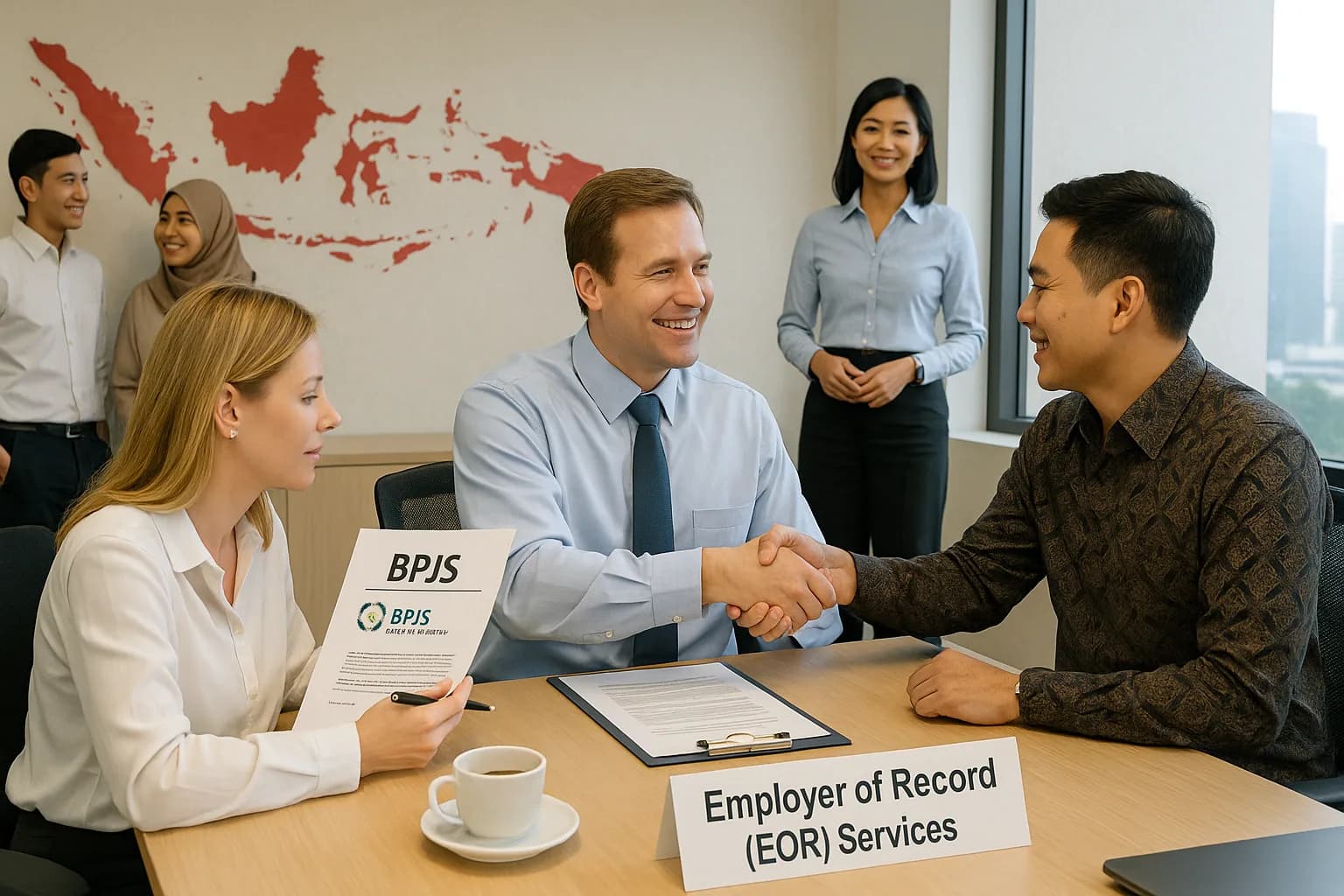
Hiring talent in Indonesia through an Employer of Record (EOR) service has become one of the fastest ways for foreign companies to enter the market. With Indonesia’s labor force of more than 135 million workers (BPS 2024) and its position as the fourth-largest workforce in the world, EOR services promise speed, compliance, and simplicity. Instead of spending 6–10 weeks setting up a PT PMA, a company can hire talent legally within 1–10 days through an EOR.
But despite the appeal, many international companies misunderstand how EOR works in Indonesia. This leads to legal issues, payroll mistakes, unexpected liabilities, and in some cases, penalties from Indonesian authorities. The truth is, Indonesia’s manpower framework is one of the most formalized in Southeast Asia—especially after the Job Creation Law—and failing to understand local requirements can cost companies far more than the price of the EOR service itself.
This article explores the top mistakes companies make when applying for Employer of Record (EOR) services in Indonesia, supported by local regulatory context and industry data. If you’re planning to hire in Indonesia without setting up a local entity, this guide will help you avoid the most common pitfalls and operate with confidence.
Understanding the EOR Landscape in Indonesia
Before diving into the mistakes, it’s important to understand what an EOR legally does. In Indonesia, an EOR is the formal legal employer of the worker. The service provider hires the employee on behalf of a foreign company, manages payroll, calculates taxes, administers BPJS (the Indonesian social security system), and ensures compliance with labor laws—all while the foreign company directs daily work.
To legally operate, an EOR must hold:
- A valid Indonesian entity
- A NIB (business license) with KBLI 78300 for manpower outsourcing and human resource management services
- Compliance with Peraturan Menteri Ketenagakerjaan No. 14/2025 (current manpower outsourcing and licensing standards)
- Ability to manage BPJS and payroll reporting
- Understanding of PDP (Personal Data Protection) Law for employee data
The challenge is: not all providers meet these requirements, and not all clients understand the legal environment they are entering. This is where problems begin.
Common Mistakes Companies Make When Applying for EOR Services in Indonesia
1. Assuming the EOR Removes All Legal Risk
One of the biggest misconceptions is that an EOR completely eliminates employer risk. Foreign companies often believe that because the EOR is the “legal employer,” the client cannot be held liable for labor conflicts or regulatory issues.
In Indonesia, that is not fully true.
Under manpower regulations and practical enforcement by the Manpower Office, a company can still be considered the functional employer if it controls:
- Day-to-day work
- Performance evaluations
- Deliverables
- Tools and work processes
In cases of employee disputes, authorities often review the working relationship holistically. This means the client company may still be exposed—especially if the role is considered core to business operations or the termination was mishandled.
EOR reduces risk, but it does not remove employer responsibility entirely.
2. Hiring for Roles That Are Legally Non-Outsourceable
Indonesia strictly regulates which roles can be outsourced or managed under a third-party employment model. Under PP 35/2021, an EOR must not be used for positions considered core business functions.
Common roles that foreign companies mistakenly try to hire through EOR include:
- Direct sales roles
- Engineering teams building core products
- Operational managers involved in revenue generation
- Manufacturing production staff
If a role is classified as core business, authorities can force the company to:
- Convert the worker into an internal employee
- Pay compensation for improper outsourcing
- Face administrative penalties
Foreign companies often assume EOR = full flexibility. In Indonesia, that is not always the case.
3. Not Understanding Indonesia’s Strict PKWT Rules
Most EOR employees in Indonesia are hired under PKWT (Fixed-Term Employment Contracts). But PKWT rules are far more detailed than many foreign companies realize.
PKWT must include:
- Exact duration
- Job scope
- Specific deliverables
- Compensation structure
- Mandatory reporting to the Ministry of Manpower within 3 working days
When companies demand “flexible” month-to-month contracts, one-day notice periods, or early termination without compensation, they inadvertently request arrangements that are not legal under Indonesian regulations.
A key regulation many companies miss:
If a PKWT contract is terminated early, compensation must be paid based on:
Remaining contract period × full salary × 1/12
This surprises many companies when they first work with EOR services.
4. Underestimating Employer BPJS Costs
Foreign companies often miscalculate the true employer cost in Indonesia by forgetting mandatory contributions to BPJS Ketenagakerjaan (employment insurance) and BPJS Kesehatan (health insurance).
Employer BPJS Contributions
- BPJS Kesehatan: 4% of salary (capped at IDR 12 million)
- BPJS Ketenagakerjaan: 4%–6% depending on role and risk
- JKK (0.24%–1.74%)
- JKM (0.3%)
- JHT (3.7%)
- JP (2%)
Employer contributions typically add 6%–10% to total payroll cost.
BPJS compliance in Indonesia is strict, and over 30% of companies have been reported to experience BPJS reporting issues or delays (BPJS 2023–2024 data). When using an EOR, the employer cost must be calculated accurately to avoid budget problems.
5. Working With an EOR That Is Not Legally Licensed in Indonesia
Some global EOR companies operate in Indonesia without the correct KBLI, outsourcing license, or reporting capabilities. They may have a local partner, but not a compliant local entity. The client often only realizes this when:
- Payroll mistakes occur
- An employee files a dispute
- BPJS reports do not match Ministry of Manpower data
- Authorities request documentation
If the EOR is not legally authorized, contracts can be considered invalid, exposing the client and employee to significant risk.
When evaluating EOR providers, companies must ensure the provider has:
- KBLI 78200
- Acknowledgment under Permenaker 6/2021
- BPJS reporting access
- Ability to file employment reports to the Ministry of Manpower
- A physical entity registered in Indonesia
Skipping this due diligence is one of the costliest mistakes.
6. Assuming the EOR Handles Everything Automatically
Different EOR providers in Indonesia offer different levels of service. Some only process payroll. Others manage full HR administration. Many foreign companies assume the provider handles all compliance obligations—but do not confirm it.
Important questions to clarify include:
- Who files monthly Article 21 tax withholding?
- Who submits annual employee tax reports?
- Who manages BPJS registration and adjustments?
- Who updates wage structure compliance under Permenaker 5/2023?
- Who handles overtime, leaves, and THR calculations?
If the EOR does not handle every aspect, someone must. Otherwise, the employer risks:
- Tax penalties
- BPJS arrears
- Incorrect THR (holiday allowance) calculations
- Employee disputes
Misalignment of expectations is extremely common.
7. Misclassifying Contractors as EOR Employees or Vice Versa
Remote companies often want to hire Indonesian talent as independent contractors to avoid payroll tax, BPJS, and other labor obligations. But Indonesian authorities examine:
- Working hours
- Exclusivity
- Reporting structure
- Use of company tools
- Whether the role is long-term
Most “contractor” arrangements end up being classified as employment. Misclassification can lead to:
- Back taxes + penalties
- Mandatory conversion to employee
- Compensation for all employment benefits owed
- Disputes with DJP (tax authority) and Manpower Office
Worker misclassification is one of the top three causes of manpower disputes in Indonesia, based on recurring trends and DJP annual reports.
8. Expecting 1-Month or Ultra-Flexible Contracts
EOR hiring is not equivalent to gig work. Indonesia requires:
- Minimum contract transparency
- Proper PKWT structures
- Compensation for early termination
Most EOR providers impose minimum 3–12 month hiring periods, aligned with Indonesian labor law. Shorter commitments are either illegal or too risky to enforce.
Companies that expect “ultra-flexible” hiring often run into compliance problems. Indonesia values employment stability—something foreign companies sometimes underestimate.
9. Overlooking Data Protection Requirements
Indonesia’s Personal Data Protection (PDP) Law requires strict handling of:
- Passport scans
- Tax ID (NPWP)
- Bank accounts
- Salary data
- Employee contracts
- BPJS membership data
Not all EOR providers have compliant systems. Some use unsecured email or spreadsheets to exchange sensitive information. This exposes both the worker and the client to serious data protection risks. If the provider is not PDP-ready, it should be considered a red flag.
10. Using EOR as a Permanent Substitute for a Local Entity
EOR is ideal for:
- Market testing
- Hiring a small team quickly
- Running a lightweight operation
- Short- to medium-term expansion
However, if a foreign company:
- Hires many staff
- Generates revenue
- Maintains long-standing operations
- Manages a functional team in Indonesia
…then the company could be viewed by the tax authority as having a Permanent Establishment (PE) in Indonesia. This triggers:
- Corporate Income Tax exposure (22%)
- VAT obligations
- Mandatory PT PMA registration
EOR is a hiring solution—not a long-term replacement for a local entity.
FAQ About Employer of Record (EOR) Services in Indonesia
1. Can I hire any type of employee through an EOR in Indonesia?
No. Roles considered core business functions cannot be outsourced or hired via EOR under PP 35/2021.
2. How long does it take to hire someone through an EOR?
Most EOR hires can start in 1–10 days, depending on documentation and onboarding.
3. Can EOR employees be moved to a PT PMA later?
Yes. Conversion is allowed and common when a company transitions from market entry to full incorporation.
4. What is the biggest hidden cost of hiring through an EOR?
Employer BPJS contributions, often adding 6%–10% to salary costs.
5. Is EOR legal for long-term hiring?
Short- to medium-term, yes. But long-term activity may be interpreted as Permanent Establishment (PE), requiring a PT PMA.
Conclusion
Applying for Employer of Record (EOR) services in Indonesia offers businesses a fast, compliant, and highly strategic approach to hiring talent without establishing a local legal entity. However, misunderstanding Indonesian labor regulations, tax obligations, BPJS requirements, and the limits of outsourcing can expose companies to significant operational and legal risk.
The good news is this: most of these mistakes are avoidable. With the right guidance, proper legal understanding, and a fully licensed EOR provider, international companies can expand into Indonesia smoothly and focus on growth instead of compliance headaches.
If your company is planning to hire employees in Indonesia, CPT Corporate can help you navigate every compliance requirement—from payroll taxes and BPJS registration to legally sound PKWT contracts and proper workforce classification.
Contact CPT Corporate today to ensure your hiring strategy in Indonesia is fully compliant, risk-free, and aligned with the country’s evolving regulations. Let’s make your expansion into Indonesia simple, legal, and successful.