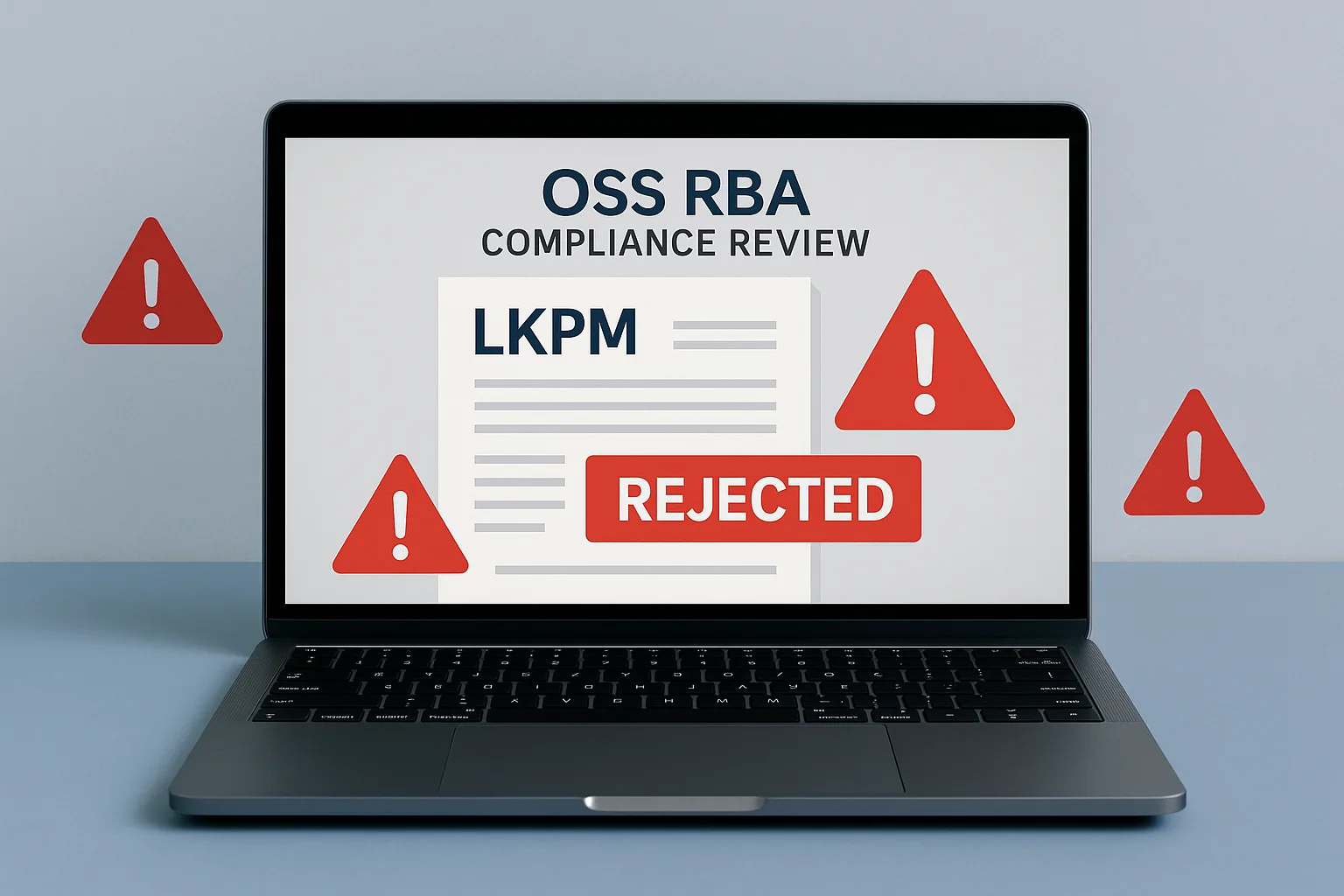
Indonesia’s online licensing ecosystem has evolved rapidly since the introduction of the OSS RBA (Online Single Submission – Risk Based Approach). While the system promises faster processing and streamlined investment compliance, many businesses still run into a common and costly problem: their LKPM (Laporan Kegiatan Penanaman Modal) submissions get rejected or flagged.
A rejected LKPM is more than an administrative inconvenience. For PMA companies, PT locals, and even small-scale businesses, a rejected report can disrupt licensing status, freeze certain OSS features, trigger audits, and—if left unresolved—lead to severe administrative sanctions. Despite this, a significant number of companies continue to struggle. One recent regional study showed that out of 26,947 companies with NIB in West Java, only 37.9% had submitted LKPM—highlighting how widespread non-compliance and submission problems are.
This article breaks down why LKPM submissions are often rejected, what issues OSS RBA flags the most, and what your company can do to avoid these disruptions.
What Is LKPM and Why OSS RBA Flags Your Submission
LKPM is the mandatory investment activity report required under BKPM Regulation No. 7/2018 and subsequent updates. All companies with investment licenses—especially PMAs and medium/large domestic entities—must regularly report their investment realization, business progress, workforce numbers, and operational challenges. Under the OSS RBA system, these reports are filed quarterly or semi-annually depending on company scale.
But while digitalization was meant to simplify compliance, the transition to OSS RBA has brought new complexities. Data migration issues, changes in reporting templates, and stricter consistency checks now mean the system is far more sensitive to mismatches or irregularities. Many businesses submit LKPM only to receive a frustrating flagged status or outright rejection.
Understanding why the system rejects LKPM is the first step to preventing it.
Why LKPM Submissions Get Rejected in OSS RBA
OSS RBA flags and rejects LKPM submissions for a range of reasons. Below are the most common triggers, based on regulatory guidance, corporate compliance experiences, and published reports from law firms, consultants, and industry observers.
1. Data Mismatch Between LKPM, Previous Reports, and OSS Records
This is the number one reason for LKPM rejections.
The OSS RBA cross-checks the numbers you submit—investment value, capital realization, production value, manpower, and operational updates—against:
- previous LKPM submissions
- your company’s licensing data (NIB, KBLI, project stages)
- commitments declared in earlier investment plans
If your LKPM suddenly reports drastically lower or higher investment realization without explanation, or workforce numbers don’t match prior quarters, the system may flag it as inconsistent.
Many companies, especially PMAs, struggle with this because internal departments don’t synchronize data. For example, accounting might input manpower differently from HR, or directors may not update NIB activities after expanding operations.
Why OSS cares: mismatched data indicates possible non-compliance, inaccurate reporting, or business activities outside licensed scope.
2. Incorrect or Outdated KBLI Classification
Another major cause of LKPM rejection is incorrect KBLI (Indonesian Standard Business Classification).
Many companies obtained their NIB years ago and never updated their KBLI when expanding or changing activities. OSS RBA automatically cross-checks whether:
- your real activity matches the KBLI listed
- your LKPM activities align with what your business is legally allowed to do
If you report progress in a sector not covered by your KBLI, the system will flag it.
For example, a company licensed under KBLI for wholesale trading but reporting manufacturing investment will be instantly rejected.
3. Missing or Incomplete LKPM Fields
Many submissions fail because companies skip key sections such as:
- details of investment realization
- updates on construction or production
- workforce numbers
- challenges faced during the reporting period
- business progress narrative
OSS RBA enforces completeness. Even if you have zero investment for the period (“laporan nihil”), you must still submit required descriptions, otherwise the system treats the report as incomplete.
Incomplete information is also common in companies that use outdated templates or rely on old LKPM habits from pre-OSS systems.
4. Late Submission or Missed Reporting Deadlines
LKPM must be submitted:
- Quarterly for medium-large companies
- Semi-annually for small companies
- According to project stage for certain investment categories
Late submissions are automatically flagged. Some companies mistakenly believe they only need to submit when there is investment activity, but LKPM is mandatory even for zero activity.
Legal commentary notes that repeated failure to submit LKPM can lead to:
- warnings
- freeze of OSS access
- eventual revocation of licenses
This is why many companies in Indonesia, especially dormant or low activity PMAs, suddenly find themselves locked out of OSS or unable to process license changes.
5. Technical Errors, System Migration Issues, and Upload Failures
User reports and industry news highlight persistent technical problems in OSS RBA, such as:
- incompatible file formats
- data migration errors from older OSS versions
- form submission glitches
- sudden validation errors
- server timeouts
These issues can cause legitimate submissions to be rejected or appear incomplete.
Though technical, the OSS RBA still treats these as submission failures, putting responsibility on the company rather than the system. This means you must allocate more time to verify, recheck, and re-submit before the deadline.
6. Internal Inconsistency: Accounting vs HR vs Director Reporting
Corporate teams often fail to align their data. A very common scenario for PMA companies:
- Accounting uses internal investment figures not aligned with the investment plan.
- HR reports workforce differently from what’s in LKPM templates.
- Directors assume previous data is correct although the OSS RBA has changed formats.
This creates inconsistent submissions, and the system uses automated checks to reject mismatched figures.
7. Not Understanding the New OSS RBA Requirements
Many businesses still rely on outdated procedures and don’t realize that:
- OSS RBA uses stricter validation
- LKPM templates change
- KBLI classifications must match operational reality
- business activities need updating in NIB before reporting
Consulting companies often find that businesses with rejected LKPMs have never updated their OSS profile after their initial licensing—even after years of operation.
Consequences of Rejected or Flagged LKPM
A rejected LKPM is not a minor issue. Several legal and regulatory sources warn that non-compliance can lead to:
- suspension of licensing activities
- inability to process permits or variations in OSS
- disruption to business operations
- OSS-RBA access restrictions
- increased audit risk from authorities
- potential revocation of business licenses
For companies reliant on ongoing licensing—manufacturers, logistics firms, construction companies, and especially PMAs—once your OSS access is frozen, your operational capabilities can be severely disrupted.
How to Ensure Your LKPM Is Approved on the First Submission
The good news: most LKPM rejections are preventable.
Here are the most effective steps companies use to reduce rejection risk:
1. Align your internal data
Coordinate between accounting, HR, and management so all departments report consistent figures.
2. Double-check your KBLI
Ensure business activities in your NIB match your real operations. If you expanded, update your KBLI before submitting LKPM.
3. Prepare data early
Don’t wait until the deadline. Start internal data collection 1–2 weeks before submission.
4. Complete every field
Even if it’s a zero-activity quarter, write the required narrative and confirm all fields are filled.
5. Keep historical LKPMs accessible
Review previous submissions to ensure consistency.
6. Maintain documentation
Keep supporting documents in case BKPM or OSS officers request clarification.
7. Consider compliance support
For PMA companies dealing with multi-department data or regulatory changes, outsourcing LKPM preparation often reduces errors dramatically.
FAQ: LKPM Rejection and OSS RBA Issues
1. Can LKPM be submitted late?
You can submit late, but OSS RBA will flag the submission and repeated delays may trigger sanctions or OSS access restrictions.
2. What if my company had zero investment this quarter?
You must still submit LKPM. Zero activity must be reported properly with a narrative.
3. My KBLI doesn’t match my activity. Can I still submit?
You can, but the system may reject it. You should update your KBLI in OSS before submitting LKPM.
4. What happens if LKPM is repeatedly rejected?
Your OSS access may be limited, and you may be unable to issue, amend, or renew licenses, depending on the severity.
5. Will OSS RBA notify me why LKPM is rejected?
Usually, yes. OSS provides brief notes or flagged sections, but the explanation may be technical or limited.
Conclusion
LKPM rejection is a growing issue in the OSS RBA era, mostly due to stricter validation and companies not keeping their data and licensing updated. Whether it’s due to mismatched figures, outdated KBLI, incomplete reporting, late submission, or technical errors, the cause is almost always preventable.
With over 60% of companies failing to submit LKPM on schedule, compliance is now a bigger challenge—and opportunity—for businesses that want to operate smoothly in Indonesia.
Ensuring accurate, consistent, and timely LKPM submission is not just about compliance; it’s about protecting your business continuity and avoiding unnecessary regulatory risk.
If your LKPM has been rejected, flagged, or you’re unsure whether your data matches your OSS records, CPT Corporate can help. Our team assists businesses—especially PMAs—in updating OSS profiles, repairing rejected submissions, and ensuring your compliance processes run smoothly.
Talk to CPT Corporate today and prevent future disruptions before they happen.